I'm a collector of sentences. My most cherished notebook is this little black, leather-bound book that I started using when I was around fourteen. In it are sentences, passages, and poems that struck me at some point in my life. Flipping through it feels like lighting up parts of my heart, as if the spirits of my younger selves are resonating with my present one.
This is the first post in a series in which I hope to share some of these such sentences as I come across them.
There's a fragment of a poem I'd like to share for its strikingly delicate imagery. These lines come from Yong Shu Hoong's poem, Practical Concerns, written after the passing of Singapore's founding father, Lee Kuan Yew, in 2015. Lee Kuan Yew was a statesman unrelenting in his attention to practical matters. On his passing, more than a hundred thousand people lined the streets along the funeral route in "torrential rain" (the rain on the day of his funeral is always described as torrential). This is the moment which Yong Shu Hoong captures:
Who will sweep the flowers from the streets
after persistent queues uncoil, ......
On Monday, habitual winds will lightly ruffle
the white carpet, to show hints of the asphaltUnderneath—a gleaming arrow pointing
at all the work yet to be disburdened.— Yong Shu Hoong, Practical Concerns
I was not present at the funeral (Lee Kuan Yew passed away in the middle of my Junior College examinations—a demanding period for the Singaporean student—and although now, having gained some perspective over the years, I do regret chosing to study instead, I'm sure the chief architect of Singaporean society and education would have approved of the decision), so I can't speak to how the procession appeared and whether it was indeed carpeted in white flowers. In my mind the procession has always been this long unwavering stretch of road, flanked by crowds and tropical trees and ferns, buffeted by torrential rain. This poem has added a sombre white carpet to the memory. And such a heavy carpet can indeed only be lightly ruffled.
The habitual winds befit the grieving mind (though they belie the reality of Singapore winds, which are apt to invert and break weak umbrellas). As the wind gestures toward work yet to be done, habit becomes especially evocative when set against Lee Kuan Yew. A tribute by former Deputy Prime Minister Heng Swee Keat—focused on Mr Lee's Red Box—makes this echo more visible.
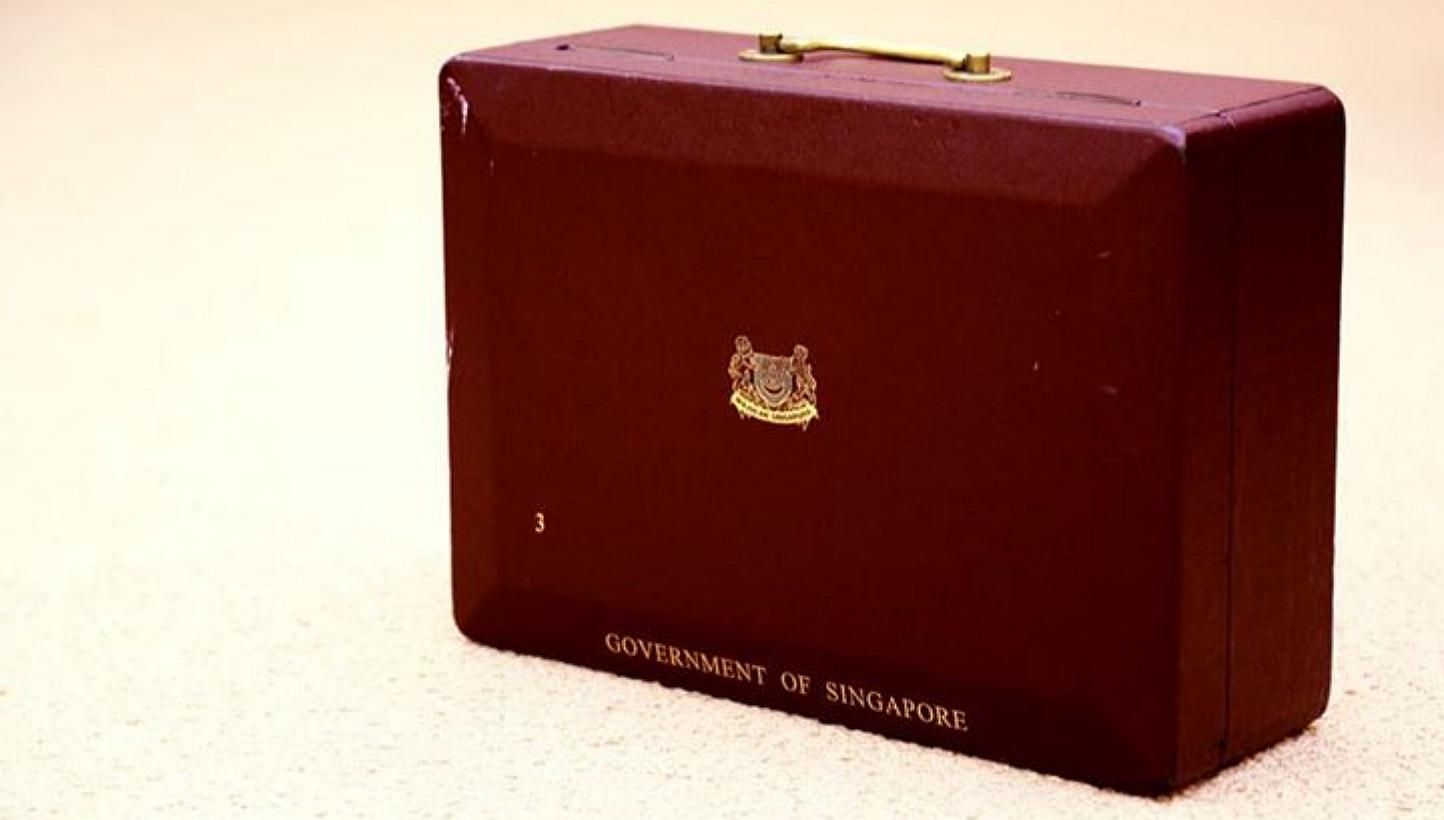
The founding father used a red box extensively to transport documents on matters big and small, ranging from "communications with foreign leaders, observations about the financial crisis, instructions for the Istana grounds staff, or even questions about some trees he had seen on the expressway." There is a passage in the tribute on how Mr Lee grieved for the passing of his wife with his mind still on practical concerns:
In 2010, Mr Lee was hospitalised again, this time for a chest infection. While he was in the hospital, Mrs Lee passed away. Mr Lee has spoken about his grief at Mrs Lee’s passing. As soon as he could, he left the hospital to attend the wake at Sri Temasek.
At the end of the night, he was under doctor’s orders to return to the hospital. But he asked his security team if they could take him to the Singapore River instead. It was late in the night, and Mr Lee was in mourning. His security team hastened to give a bereaved husband a quiet moment to himself.
As Mr Lee walked slowly along the bank of the Singapore River, the way he and Mrs Lee sometimes did when she was still alive, he paused. He beckoned a security officer over. Then he pointed out some trash floating on the river, and asked, “Can you take a photo of that? I’ll tell my PPS what to do about it tomorrow.” Photo taken, he returned to the hospital.
I was no longer Mr Lee’s PPS at the time. I had moved on to the Monetary Authority of Singapore, to continue with the work to strengthen our financial regulatory system that Mr Lee had started in the late 1990s. But I can guess that Mr Lee probably had some feedback on keeping the Singapore River clean. I can also guess that the picture and the instructions were ferried in Mr Lee’s red box the next morning to the office. Even as Mr Lee lay in the hospital. Even as Mrs Lee lay in state.
— Heng Swee Keat
Heng Swee Keat recalls that Lee Kuan Yew's Red Box contained daily notes and instructions for work that had to be carried out. If there is any image that would go with Yong Shu Hoong's final line of the poem—"at all the work yet to be disburdened", it would be this flurry of activity of taking the notes from Mr Lee's Red Box, transcribing them and following up with instructions for the government.
Disburdening ends the image with a pause. A reader considers for a moment this comprehensible but foreign word, considers how the prefix dis- modifies burdened—negation; reversal; removal? Enough time to let the concerns in: who will do the disburdening? What remains to be disburdened? The flowers; the grief; the work left for the country.